Scott Anderson at WardsAuto.com had and interesting article called New EPA Ratings Hit Fuel Sippers the Hardest. Here is what they said along with my comments.
Makers of the thriftiest cars and trucks on the road have less to brag about under new vehicle fuel-economy ratings the government says better reflect Americans’ real-world driving.
The U.S. Environmental Protection Agency recently released new vehicle fuel-economy estimates that, for the first time, account for current interstate highway speeds, heavier use of air conditioning and other modern-day driving habits. In some ways it is hard for me to believe that it has taken this long for the EPA to get around to this? When did we change the speed limit from 55 MPH to 70 MPH/ That is pretty much the day when people started driving 80 MPH. When did you no longer need a radar detector? Remember back in the days of 55 MPH on the freeway, everyone had a radar detector. I think over that time period I bought 3 different types because the technology kept changing so fast. Another thing that doesn't make sense to me is when they say "air conditioning use". In most cars the auto setting or default setting is air conditioning on? I am constantly turning my A/C button off in my car. During the winter months the only time I need to run the A/C is when I have 3 people in the car with me and the windows get all fogged up. Otherwise you don't need it.
Under the EPA’s new ratings system, city mileage for all ’07 U.S. light vehicles, on average, falls 12%, while average highway estimates drop 8%. Combined fuel economy for the current fleet is about 10% lower. I am sure the automakers will whine about this and complain or already have but come on fellas the Corporate Average Fuel Economy hasn't changed since 1988. What was up with continuous improvement during this time frame, I know there wasn't any. I would love to drive a Ford Expedition that gets 30 MPG but it is not available. No one cared, fuel was cheap.
For some vehicles, particularly fuel-sipping power trains, the new ratings system can mean as much as a 30% reduction in city fuel economy and a 25% cut in highway driving averages.
“The most efficient vehicles on the market are gas-electric hybrids,” an EPA spokesman says. “They’re more affected downward as a percentage than other vehicles. Smaller engines pay a higher penalty for accessory usage, such as air conditioning.” This makes sense, when you consider the amount of power required to run an A/C compressor or to fire up 2 heated electric seats. That little 2.0L engine is going to pay a lot higher price than my 5.4L V8. It is all in the percentages. It is sort of like comparing a Clydesdale horse to a pony pulling a wagon. Put another 4 people on the wagon and the Clydesdale doesn't even know they are there. The pony on the other hand will just stop and eat grass.
Toyota Prius fuel economy dips 16% as result of new ratings.
For example, Toyota Motor Corp.’s Prius hybrid-electric vehicle saw its combined city/highway numbers fall from 55 mpg (4.2 L/100 km) to 46 mpg (5.1 L/100 km), or a 16% drop, according to the new measurements. The impact is far less on trucks and SUVs. The ’07 Chevrolet Tahoe, for instance, when equipped with a V-8 5.3L engine, slipped from a combined rating of 18 mpg (13 L/100 km) to 16 mpg (14.7 L/100). So the Prius goes from sort of amazing gas mileage to just great gas mileage. The Tahoe goes from crappy mileage to really crappy. The point here is that when you buy a car and the sticker says here is the mileage that you should get you really should get that mileage. Don't you think? It is sort of truth in advertising. I don't really care what mileage the car will get sitting on the test dyno in the back of a lab, I want to know what I will get when I a barrelling down the road at 80 MPH with the heated seats on, the A/C blarring (because I forgot to shut it off), my arc source head lamps and fog lights on, navigation system's LCD telling me which way to turn, charging my Treo and the Bose stero system thumping out the new Daughtry CD.
The new mileage ratings do not affect auto makers’ corporate average fuel economy totals. It is funny how the article ends with this. This is the root of the problem. When the SUV craze hit the U.S. market and we had low fuel prices there was no incentive to improve. And it looks like here we are in the year 2007 flirting with $3 gas prices again and we still don't have an incentive to improve. American's want to drive large cars, we will always want this, if the CAFE targets don't change then we will never improve. The auto industry has not self regulated it self over the last 20 years so what makes us think they will do it now. It was a missed opportunity to not improve the CAFE over the last 20 years it is a missed opportunity now. The Japanese car manufactures on the other hand have quietly develop powerful gas engines and hybrid electric vehicles. The Europeans manufactures have developed small displacement diesel engines to cope with $6.50 per gallon gas prices. The "D3" automakers have not.
Sunday, March 11, 2007
New EPA Ratings Hit Fuel Sippers Hardest

Tuesday, April 18, 2006
Top 10 Hybrid Myths
Businessweek had an interesting article about the 10 ten hybrid myths. The myths include:
1. You need to plug in a hybrid car.
2. Hybrid batteries need to be replaced.
3. Hybrids are a new phenomenon.
4. People buy hybrids only to save money on gas.
5. Hybrids are expensive.
6. Hybrids are small and underpowered.
7. Only liberals buy hybrids.
8. Hybrids pose a threat to first responders.
9. Hybrids will solve all our transportation, energy, and environmental problems.
10. Hybrid technology is only a fad.
For the complete article.
Related gas saving articles:
- Looking for Cheap Gas Find the Best Prices In Your Area
- Gas Saving Products Facts or Fiction
- Save Money with Gas Rebate Cards
- Are there fuel effiecient SUVs?
- Looking for a new car, compage gas mileage of every car
Looking for investment related links checkout these articles:
- Investing in Gold
- Investing in Mutual Funds
- How to become the next millionaire
- Home based businesses
- Investing In Mutual Funds
- Get Rich Quick
Thanks for visiting please check out my other blogs and websites:
Sunday, January 29, 2006
"Gas-Saving" Products: Fact or Fuelishness? the truth about fuel additives
Gas prices are up, and so is the volume of advertising for "gas-saving" products. When gasoline prices rise, consumers often look for ways to improve fuel efficiency. Although there are practical steps you can take to increase gas mileage, the Federal Trade Commission (FTC) warns you to be wary of any gas-saving claims for automotive devices or oil and gas additives. Even for the few gas-saving products that have been found to work, the savings have been small.
"Gas-Saving" Advertising Claims
Be skeptical of the following kinds of advertising claims. "This gas-saving product improves fuel economy by 20 percent."Claims usually tout savings ranging from 12 to 25 percent. However, the Environmental Protection Agency (EPA) has evaluated or tested more than 100 alleged gas-saving devices and has not found any product that significantly improves gas mileage. In fact, some "gas-saving" products may damage a car's engine or cause substantial increases in exhaust emissions.
The gas-saving products on the market fall into clearly defined categories. Although the EPA has not tested or evaluated every product, it has tried to examine at least one product in each category. See "Devices Tested by EPA" at the end of this brochure for category descriptions and product names.
"After installing your product on my car, I got an extra 4 miles [6.4 kilometers] per gallon [3.8 liters]."Many ads feature glowing testimonials by satisfied customers. Yet, few consumers have the ability or the equipment to test for precise changes in gas mileage after installing a gas-saving product. Many variables affect fuel consumption, including traffic, road and weather conditions, and the car's condition.
For example, one consumer sent a letter to a company praising its "gas-saving" product. At the time the product was installed, however, the consumer also had received a complete engine tune-up - a fact not mentioned in the letter. The entire increase in gas mileage attributed to the "gas-saving" product may well have been the result of the tune-up alone. But from the ad, other consumers could not have known that.
"This gas-saving device is approved by the Federal government."No government agency endorses gas-saving products for cars. The most that can be claimed in advertising is that the EPA has reached certain conclusions about possible gas savings by testing the product or by evaluating the manufacturer's own test data. If the seller claims that its product has been evaluated by the EPA, ask for a copy of the EPA report, or check http://www.epa.gov/ for information.
In some instances, false claims of EPA testing or approval have been made.
Product Complaints and Refunds
If you're dissatisfied with a gas-saving product, contact the manufacturer and ask for a refund. Most companies offer money-back guarantees. Contact the company, even if the guarantee period has expired.
If you're not satisfied with the company's response, contact your local or state consumer protection agency or the Better Business Bureau.
Shifting Gears: Real Money-Saving Steps
There are numerous no- or low-cost steps you can take to combat rising gas prices. The most important place to start is at the gas pump; buy only the octane level gas you need. All gas pumps must post the octane rating of the gas under the FTC's Fuel Rating Rule. Remember, the higher the octane, the higher the price. Check your owner's manual to determine the right octane level for your car.
- Here are some additional tips from the EPA to help you get better gas mileage.
- Drive more efficiently
- Stay within posted speed limits. The faster you drive, the more fuel you use. For example, driving at 65 miles per hour (mph), rather than 55 mph, increases fuel consumption by 20 percent. Driving at 75 mph, rather than 65 mph, increases fuel consumption by another 25 percent.
- Use overdrive gears. Overdrive gears improve the fuel economy of your car during highway driving. Your car's engine speed decreases when you use overdrive. This reduces both fuel consumption and engine wear.
- Use cruise control. Using cruise control on highway trips can help you maintain a constant speed and, in most cases, reduce your fuel consumption.
- Anticipate driving situations. If you anticipate traffic conditions and don't tailgate, you can avoid unnecessary braking and acceleration, and improve your fuel economy by 5 to 10 percent. In city driving, nearly 50 percent of the energy needed to power your car goes to acceleration. Go easy on the gas pedal and brakes. "Jack-rabbit" starts and sudden stops are wasteful.
- Avoid unnecessary idling. Turn off the engine if you anticipate a lengthy wait. No matter how efficient your car is, unnecessary idling wastes fuel, costs you money and pollutes the air.
- Combine errands. Several short trips taken from a cold start can use twice as much fuel as one trip covering the same distance when the engine is warm.
Remove excess weight from the trunk. Avoid carrying unneeded items, especially heavy ones. An extra 100 pounds in the trunk reduces a typical car's fuel economy by one to two percent. - Maintain your car
- Keep your engine tuned. Studies have shown that a poorly tuned engine can increase fuel consumption by as much as 10 to 20 percent depending on a car's condition. Follow the recommended maintenance schedule in your owner's manual; you'll save fuel and your car will run better and last longer.
- Keep your tires properly inflated and aligned. Car manufacturers must place a label in the car stating the correct tire pressure. The label usually is on the edge of the door or door jamb, in the glove box, or on the inside of the gas cap cover. If the label lists a psi (pounds per square inch) range, use the higher number to maximize your fuel efficiency.
- Underinflated tires cause fuel consumption to increase by six percent.
- Change your oil. Clean oil reduces wear caused by friction between moving parts and removes harmful substances from the engine. Change your oil as recommended by the vehicle manufacturer.
- Check and replace air filters regularly. Your car's air filter keeps impurities in the air from damaging internal engine components. Not only will replacing a dirty air filter improve your fuel economy, it also will protect your engine. Clogged filters can cause up to a 10 percent increase in fuel consumption.
- Consider buying a fuel efficient vehicleDeciding which vehicle to buy may be the most important fuel economy decision you make. The difference between a car that gets 20 MPG (miles per gallon) and one that gets 30 MPG amounts to $1,500 over 5 years, assuming gas costs $1.50 per gallon and you drive 15,000 miles a year.
Visit http://www.fueleconomy.gov/ for more information. You'll find gas mileage estimates and other data from EPA for 1985-2003 model year cars.
EPA Evaluation Efforts
The EPA evaluates or tests products to determine whether their use will result in any significant improvement or detriment to fuel economy. However, the EPA cannot say what effect gas-saving products will have on a vehicle over time because it hasn't conducted any durability tests. It's possible that some products may harm the car or may otherwise adversely affect its performance. In fact, today's vehicles' emission control systems are very sophisticated and complex. They have On Board Diagnostic features that alert the driver to problems associated with the emission control and fuel delivery systems. Retrofit products may have an adverse effect on these systems.
Devices Tested by EPA
The following list categorizes various types of "gas-saving" products, explains how they're used and gives product names. Those with asterisks may save measurable, but small, amounts of gas. All others have been found not to increase fuel economy.
Air Bleed Devices. These devices bleed air into the carburetor. They usually are installed in the Positive Crankcase Ventilation line or as a replacement for idle-mixture screws.
The EPA has evaluated the following products: ADAKS Vacuum Breaker Air Bleed; Air-Jet Air Bleed; Aquablast Wyman Valve Air Bleed; Auto-Miser; Ball-Matic Air Bleed; Berg Air Bleed; Brisko PCV; Cyclone-Z; Econo Needle Air Bleed; Econo-Jet Air Bleed Idle Screws; Fuel Max*; Gas Saving Device; Grancor Air Computer; Hot Tip; Landrum Mini-Carb; Landrum Retrofit Air Bleed; Mini Turbocharger Air Bleed; Monocar HC Control Air Bleed; Peterman Air Bleed; Pollution Master Air Bleed; Ram-Jet; Turbo-Dyne G.R. Valve.
Vapor Bleed Devices. These devices are similar to the air bleed devices, except that induced air is bubbled through a container of a water and anti-freeze mixture, usually located in the engine compartment.
The EPA has evaluated: Atomized Vapor Injector; Frantz Vapor Injection System; Hydro-Vac: POWERFUeL; Mark II Vapor Injection System; Platinum Gasaver; V-70 Vapor Injector; SCATPAC Vacuum Vapor Induction System: Econo-Mist Vacuum Vapor Injection System; Turbo Vapor Injection System.
Liquid Injection. These products add liquid into the fuel/air intake system and not directly into the combustion chamber. The EPA has evaluated: Goodman Engine System-Model 1800; Waag-Injection System*.
Ignition Devices. These devices are attached to the ignition system or are used to replace original equipment or parts.The EPA has evaluated: Autosaver; Baur Condenser; BIAP Electronic Ignition Unit; Fuel Economizer; Magna Flash Ignition Control System; Paser Magnum/Paser 500/Paser 500 HEI; Special Formula Ignition Advance Springs.
Fuel Line Devices (heaters or coolers). These devices heat the fuel before it enters the carburetor. Usually, the fuel is heated by the engine coolant or by the exhaust or electrical system.The EPA has evaluated: FuelXpander; Gas Meiser I; Greer Fuel Preheater; Jacona Fuel System; Optimizer; Russell Fuelmiser.
Fuel Line Devices (magnets). These magnetic devices, clamped to the outside of the fuel line or installed in the fuel line, claim to change the molecular structure of gasoline.
The EPA has evaluated: PETRO-MIZER; POLARION-X; Super-Mag Fuel Extender; Wickliff Polarizer [fuel line magnet/intake air magnet].
Fuel Line Devices (metallic). Typically, these devices contain several dissimilar metals that are installed in the fuel line, supposedly causing ionization of the fuel.
The EPA has evaluated: Malpassi Filter King [fuel pressure regulator]; Moleculetor.
Mixture Enhancers (under the carburetor). These devices are mounted between the carburetor and intake manifold and supposedly enhance the mixing or vaporization of the air/fuel mixture.
The EPA has evaluated: Energy Gas Saver; Environmental Fuel Saver; Gas Saving and Emission Control Improvement Device; Glynn-50; Hydro-Catalyst Pre-Combustion Catalyst System; PETROMIZER SYSTEM; Sav-A-Mile; Spritzer; Turbo-Carb; Turbocarb.
Mixture Enhancers (others). These devices make some general modifications to the vehicle intake system.
The EPA has evaluated: Basko Enginecoat; Dresser Economizer; Electro-Dyne Superchoke; Filtron Urethane Foam Filter; Lamkin Fuel Metering Device; Smith Power and Deceleration Governor.
Internal Engine Modifications. These devices make physical or mechanical function changes to the engine.
The EPA has evaluated: ACDS Automotive Cylinder Deactivation System*; Dresser Economizer; MSU Cylinder Deactivation*.
Accessory Drive Modifiers. These devices reduce power to specific auto accessories.
The EPA has evaluated: Morse Constant Speed Accessory Drive **; P.A.S.S. Kit**; PASS Master Vehicle Air Conditioner**.
Fuels and Fuel Additives. These materials are added to the gas tank.
The EPA has evaluated: Bycosin; EI-5 Fuel Additive; Fuelon Power; Johnson Fuel Additive; NRG #1 Fuel Additive; QEI 400 Fuel Additive; Rolfite Upgrade Fuel Additive; Sta-Power Fuel Additive; Stargas Fuel Additive; SYNeRGy-1; Technol G Fuel Additive; ULX-15/ULX-15D; Vareb 10 Fuel Additive; XRG #1 Fuel Additive.
Oils and Oil Additives. Usually these materials are poured into the crankcase. The EPA has evaluated: Analube Synthetic Lubricant; Tephguard.
Driving Habit Modifiers. These are lights or sound devices to tell the driver to reduce acceleration or to shift gears.
The EPA has evaluated: AUTOTHERM**; Fuel Conservation Device; Gastell; IDALERT**.
Miscellaneous. The EPA has evaluated: BRAKE-EZ; Dynamix; Fuel Maximiser; Gyroscopic Wheel Cover; Kamei Spoilers**; Kat's Engine Heater; Lee Exhaust and Fuel Gasification EGR; Mesco Moisture Extraction System; P.S.C.U. 01 Device; Treis Emulsifier.
* Indicated a very small improvement in fuel economy but with an increase in exhaust emissions. According to Federal regulations, installation of this device could be considered illegal tampering.
** Indicated a very small improvement in fuel economy without an increase in exhaust emissions. However, cost-effectiveness must be determined by the consumer for a particular application.
Saturday, January 28, 2006
2007 Chevy Tahoe Fuel Ecomony
Chevrolet has announced the debut of the 2007 Chevy Tahoe, the next generation of the industry's best-selling full-size SUV. The new Tahoe is comprehensively redesigned and delivers a sharper, more precise driving feel, more power with improved, segment-leading fuel economy, increased interior refinement and improved quietness.
Improved efficiency
A new Gen IV small-block V-8 family – the newest chapter in the small-block's 50-year history – offers more power than comparable powertrains in previous models. Fuel-saving Displacement On Demand technology also enables better fuel economy. When combined with other vehicle-wide features, including improved aerodynamics, the small-block V-8 helps give the Tahoe the segment's best fuel economy. Preliminary testing with 5.3L-equipped models shows unadjusted combined fuel economy ratings of 20.5 mpg with 2WD models and 20.1 mpg with 4WD models. That's better fuel economy than any other full-size SUV
The new Tahoe takes over at the top of the segment in sales, quality and comfort – Tahoe has been the best-selling full-size SUV since 2001. The outgoing model (along with its longer sibling, Suburban) has ranked first in the J.D. Power and Associates Initial Quality Survey for five years, topping all import and luxury models. Engineers built on Tahoe's established credentials with a “no compromises” mantra that realized improvements in many areas of performance, quality and comfort.
Contributors to the 2007 Tahoe's segment-leading capability include:
• Superior ride, handling and quietness
• Improved efficiency
• Refined interior with thoughtful conveniences built in
• Distinctive, sporty exterior design
• Enhanced safety and security
“Tahoe is known for delivering whatever its customers want, whenever they want to do it – a hard-earned reputation reflected in countless independent quality studies, buying guide recommendations and customers who have returned to buy another vehicle,” said Ed Peper, Chevrolet general manager. “The '07 model enhances the attributes that have made Tahoe the industry's best-selling full-size SUV and improves them with dramatically increased attention to detail in smoothness, quietness and refinement. We believe it is simply the best Tahoe yet.”
Superior ride, handling and quietness
The 2007 Tahoe is built on GM's new full-size SUV platform, which incorporates features such as a new, fully boxed frame, coil-over-shock front suspension, rack-and-pinion steering and an all-new, premium interior system that bolster the vehicle's comfort, quality and capability. Wider front and rear tracks enhance handling and lower the center of gravity for a more confident road feel.
Tahoe's engineers paid extensive attention to detail to ensure a quiet driving experience. It starts with a new, stiffer frame, which reduces vibrations transmitted to the passenger cabin. The strength and accuracy of the full-boxed frame also enables more precise mounting and tuning of chassis and suspension components, which also helps reduce vibration. Even the tires on the large, 17-inch standard and 20-inch available wheels, were designed to reduce noise.
Noise-reducing components and materials are used throughout the body structure, including the headliner material, door seals and front-of-dash area. The engine also features a quiet-tuned alternator and an acoustically tuned engine cover that dramatically reduces engine noise heard inside the vehicle. New door seals help reduce seal “pull away” at highway speeds, which can cause wind noise. Also, Tahoe's more slippery shape, thanks to improved aerodynamics, streamlined exterior mirrors and roof rack, and tighter body gap tolerances, makes Tahoe quieter as it slices through the air.
Tahoe also features details such as spray-in expanding foam, which helps reduce noise by filling in space to eliminate sound paths. The foam, located mostly in the A-pillars, expands to fill the void of a space. Tahoe's quietness and smoothness is complemented by the Autoride suspension system, which is standard on LTZ. This segment-exclusive bi-state, real-time damping system provides an extremely refined ride with greatly reduced body motion. The system consists of a semi-active, two-position damping control system that responds in real time to road and driving conditions, based on body and wheel motion sensors.
Tahoe's quietness and smoothness are complemented by capabilities full-size SUV customers depend on. Tahoe 4WD models offer up to 7,700 pounds (3,492 kg) of towing capability.
Related fuel saving links:
Related gas saving articles:
- Looking for Cheap Gas Find the Best Prices In Your Area
- Gas Saving Products Facts or Fiction
- Save Money with Gas Rebate Cards
- Are there fuel effiecient SUVs?
- Looking for a new car, compage gas mileage of every car
Looking for investment related links checkout these articles:
- Investing in Gold
- Investing in Mutual Funds
- How to become the next millionaire
- Home based businesses
- Investing In Mutual Funds
- Get Rich Quick
Thanks for visiting please check out my other blogs and websites:
Saturday, January 21, 2006
Hybrid tax credits a win-win situation
The credit is aimed at helping the environment and the U.S. auto industry. Last year Americans had their pick of 11 hybrid vehicles — cars and trucks that use a combination of gasoline and electric power — available in the market. This year consumers who choose one of these vehicles can take as much as $3,400 in tax credit on their purchase or lease.
The credit, part of the Energy Policy Act of 2005, is aimed at helping the environment and boosting domestic auto sales. The credit also applies to less common types of energy-efficient cars using other alternative-fuel technology. Unfortunately, the credit will be phased out for each manufacturer as they reach sales of 60,000 qualifying vehicles. This might help jump-start the auto industry temporarily and encourage consumers to buy hybrids now rather than later, but it will not encourage the long-term solutions presented by fuel-efficient cars.
Many students decide to purchase new cars when they graduate from college and begin earning regular salaries. Anything that allows them to choose an energy-efficient car should be a permanent change to the tax code, something that will continue to encourage each generation of automobile consumers to choose the most environmentally friendly option, they can afford. Because many cutting-edge technology cars are not usually the cheapest option any incentive should be a top priority.
Implementing the credit permanently also will send a strong environmental message to auto manufacturers to continue producing these efficient vehicles, as they will become increasingly popular and “cool” among consumers, especially young adults. Keeping the tax credits intact is win-win situation for the manufacturers and the environment.
The domestic manufacturers now must compete with the more-popular foreign options. The Ford Escape and Mercury Mariner still lag behind the Toyota Prius in sales, and if the new tax credit is to work, U.S. companies will be forced to come up with more in-demand and recognizable products.
In any event, now is the time for students who will soon graduate and be in the market for new vehicles to consider buying an environmentally friendly car, and they’ll save a bit when it is time to pay the Internal Revenue Service, too.
Source
Saturday, January 14, 2006
TOYOTA PONDERS A POWER SWITCH FOR HYBRIDs
TOYOTA PONDERS A POWER/ECONOMY SWITCH FOR HYBRIDS. Toyota Motor Corp. is studying technology that would equip drivers of hybrid vehicles with a switch that enables them to shift between “green” and “power” performance settings, reports The Wall Street Journal. Jim Press, president of Toyota’s U.S. sales operations, says the concept would enable the company to address criticism that it’s fuel-sipping Prius hybrid is too lethargic but its RX400h SUV hybrid is too performance-oriented. The system would allow drivers to maximize fuel economy or, in the words of another Toyota executive, “drive the wheels off” whenever they want a surge of power.
OEMs PUSH HYBRIDS, CROSSOVERS AT DETROIT SHOW. Automakers are using this week’s pre-show media events at the North American International Auto Show in Detroit to trumpet a bevy of vehicles aimed at the U.S. market’s two hottest segments: hybrids and crossovers. General Motors, Nissan and Toyota are among those adding hybrid vehicles or expanding their hybrid lineups this year. Other OEMs—including BMW, Hyundai, Subaru and Volkswagen—either plan to add hybrids a few years from now or are showing concept hybrids at the show. Companies touting new crossover vehicles—trucklike models that ride on carlike platforms—in either production or concept form include Acura, Buick, Ford, General Motors, Jeep, Lincoln and Mazda.
HONDA PREPARES DIESEL FOR US MARKET
HONDA PREPARES DIESEL ENGINE FOR U.S. Honda Motor Co. says it is developing a four-cylinder diesel engine to offer in some of the vehicles it sells in the U.S. by the end of the decade, Automotive News reports. It wasn’t clear whether Honda is developing a new engine or modifying either the 1.7- or 2.2-liter diesel it currently offers in Europe.
HONDA MIGHT BUILD MINICAR IN THE U.S. Honda Motor Co. says it will consider building its little entry-level Fit car in the U.S. if the little four-door is a success, Reuters reports. The Fit will debut in the American market in April as a Japanese-made import. Honda predicts first-year sales
between 30,000 and 40,000 units. The company is adding the Fit to its U.S. lineup to compete with an impending flood of small entry-level models from competitors. Honda tells Reuters it will
consider local production only if the Fit doesn’t cannibalize sales from its larger Civic car line.
Sunday, January 08, 2006
Diesel engines make a comeback on the Jeep Liberty
Record high gas prices pushed U.S. consumers to consider the new generation of clean-running, quiet diesels. The newest U.S. offering is the Jeep Liberty which easily exceeded it sales goal of 5000 units. As of December 22, 2005 the 8240 were sold by the Jeep brand.
Toyota's Hybrid Prius help keep the Green image
Toyota offers a fair number of gas guzzling SUVs and large pickups. However, they have managed to keep their image clean by featuring fuel effiencient vehicles such as the Prius Hybrid. Toyota started focusing on Hybrid by in the 1990's, their cars offer distinctive aerodynamic styling and feature vehicles that get almost 60 miles per gallon (MPG).
At first naysayers called hybrids nothing more than a glorified marketing strategy. Most experts felt that customers would not pay the premium price for a vehicle just based on the operating costs savings. However, consumers flocked to hybrids, could it be a trend or a feel good factor that drives the sales. Also, taking a $3000 hit on the price of the car happens once when you buy it, however, most people buy gas once or twice a week and when gas was at $3.40 a gallon driving your SUV made you feel bad every week.
The Toyota Prius sold more thand 100,000 units in 2005, outselling entire brands such as Suzuki, Audi, Hummer, and Mini. Toyota will expand it hybrid presense to the Highlander, camry and Lexus. The popularity is reinforced by the success of the Ford Escape Hybrid whose demand is greater than Ford's capacity to build them.
Friday, November 25, 2005
Weatherizing Your Home to Save Gas and Reduce Heating Cost
Weatherizing Your Home--Weatherstripping:
This guide discusses the practice of weatherizing your home through weatherstripping. Selection of materials, types of weatherstripping and buying and installing these products are discussed. Goto guide
Thursday, November 24, 2005
Home Heating Costs Save Money on Heating Costs
WSJ had an interesting chart on the cost of heating your home. Whats interesting is that the chart indicates that heating your house with electricity is less expensive than natural gas. The primary reason for this is the dramatic increase in the price of natural gas, heating oil and propane over the past 2 years. I am not sure if I believe this but I will do some additional research and check into it.
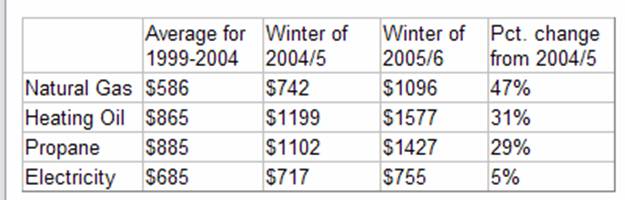
Below are some tips on reducing your home heating costs.
Reduce Heating Costs With These Money Saving Tips from About.com. If you live in a region that is cold in the winter, heating costs take a big bite out of your monthly budget for 25 - 50% of the year. Due to the rapidly escalating costs of home heating oil, propane, and kerosene, you may be paying twice as much to heat your house as you did just a few years ago. You can cut your heating costs significantly by following these money-saving tips.
- Do an energy audit of your house, identifying areas where heated air is leaking out. Check around doors, windows, fireplaces, and other areas that may feel drafty. Use caulk, weather stripping, door sweeps, plastic, and other appropriate means to close off these leaks. If your house is poorly insulated, adding additional insulation will pay for itself in reduced heating costs.
- Minimize your use of ventilation fans such as bathroom fans and kitchen hood fans in winter. A bathroom fan can suck all the heated air out of the average house in little more than an hour. Over the course of the winter, ventilation fans can increase your heating costs by a surprising amount.
- Don't heat areas of your house you don't use regularly, such as guest rooms. Close heating vents or turn back thermostats in those areas and close the doors for a painless reduction in heating costs.
- Turn down the heat and use space heaters to heat the room you spend time in.
- Keep your furnace, heat pump, or other heating equipment in top operating condition. Dirty filters reduce the efficiency of your furnace or heat pump. Poorly tuned units are inefficient and use more fuel. An annual maintenance agreement is well worth the money to ensure that your equipment is properly maintained and will last as long as possible.
Don't turn your thermostat up above the desired temperature. It won't heat up any more quickly and will make your furnace work harder. Also, while it makes sense to turn the heat back when you're sleeping or not at home, turning it down too low can actually cost you more because the contents of the house have to be re-heated in addition to the air. 68 to 70 degrees while you're home and awake, and 60 to 65% while you're asleep or not at home are reasonable temperatures. - Consider a programmable thermostat to raise and lower the temperature at pre-set times.
- Check the temperature setting on your hot water heater. If you have a dishwasher, your water should be heated to 120%. Otherwise, it can be somewhat lower. If your water heater is in an unheated space like an unfinished basement, wrap it in an insulation blanket available at hardware stores to prevent heat loss. Wash clothes in cold water whenever possible.
- It's tempting to stand under a hot shower on a cold morning for as long as possible, but cutting your shower time in half can save up to 33% on your hot water heating costs.
- In winter, open the blinds and curtains on the sunny side of the house (the south-facing side) when the sun is shining and close them as soon as the sun goes down to retain the solar heat. Close curtains on the shady side of the house (north-facing side). If you don't have curtains, consider installing some. Curtains made from heavy fabric with lots of folds (fullness) can prevent cold air from seeping in and warm air from seeping out, which reduces your heating costs.
Wednesday, November 16, 2005
HONDA’S LATEST HYBRID: A TRIPLE-MODE SNOWBLOWER
Honda Motor Co. has developed a new hybrid snowblower that uses electric motors for propulsion and a gasoline engine to drive its snowblowing mechanism and recharge its battery. It’s the fourth model in the company’s hybrid snowblower lineup, which debuted its first model in 2001. The new midsize gasoline-electric system generates up to 15 hp and features an advanced control unit that regulates throttle opening to maintain the same speed as load conditions change. Users also can preset snow discharge distances. Honda has sold more than 20,000 hybrid snowblowers since introducing the technology four years ago. The new SM1590i model is the first midsize blower to use a hybrid drive and the first with three operating modes: auto, power and manual.
Honda Posts


