The latest wapon in battling soaring heating bills is the corn furnace. The WSJ reported that one customer use to have a $400 heating bill with a traditional gas furnance. However, switching to a corn furnace his monthly bill for heating his home has dropped down to around $60. Over 30,000 corn furnaces have been snapped up this year as the nation struggles with record high natural gas prices. A major concern for consumer is the worry that traditional fuel prices may continue to rise. Corn on the other hand is $1.60 per bushel. The beauty of a corn furnace is that it hooks into your houses duct work and heats the hole house just like a traditional furnance. The corn is loaded into a hoper and a screw feeder continues to push the corn into the burner.
Monday, December 19, 2005
Heat your house with corn? Demand for corn furnaces are heating up


Save gas with an upscale economy car
General Motors, Nissan, Toyota and Honda are all planning on launching new sub-compacts next year. These new sub-compacts are not the stripped down cars of the past. The cars have options that are upscale for sub-compact cars and previously only available on higher end cars. Considering that these cars start at around $10,000 to $12,000, having the option for a six disc CD changer, power sunroofs, steering wheel mounted audio control and so on is pretty amazing. High gas prices have pushed car sales into the lead past trucks and SUVs, for the first time since 1981.
GM will be launching the new Chevrolet Aveo LT next year. This is a quick update since the vehicle was only launched 2.5 year ago. The new Aveo equiped with a manual trans gets 27 miles per gallon city and up to 35 on the highway.
Honda will be introducing the new Fit car since the Civic has grown show much that it can no longer really be considered a compact. Nissan will introduce the Versa in June and Toyota will introduce the Yaris next year.

Related gas saving articles:
- Looking for Cheap Gas Find the Best Prices In Your Area
- Gas Saving Products Facts or Fiction
- Save Money with Gas Rebate Cards
- Are there fuel effiecient SUVs?
- Looking for a new car, compage gas mileage of every car
Looking for investment related links checkout these articles:
- Investing in Gold
- Investing in Mutual Funds
- How to become the next millionaire
- Home based businesses
- Investing In Mutual Funds
- Get Rich Quick
Thanks for visiting please check out my other blogs and websites:
Sunday, December 18, 2005
Fuel effiecient SUVs
Do you live in an area with a lot of snow? Are you reluctant do drive a vehicle without 4WD or AWD? Are you concerned about high gas prices and the fact that you may need to make a choice of either living in your car or your house in order to pay for gas? Well you have options. There are several four wheel drive (4WD) or all wheel drive (AWD) models available on the market today and several of them get reasonable fuel ecomonomy for a truck based vehicle.
1. Ford Escape Hybrid, 4 cyl, 4WD, 33 City, 29 Highway
2. Toyota RAV4, 4 cyl, 21 City, 28 Highway
3. Honda CR-V, 4 cyl, 22 City, 27 Highway
4. Subaru Forester, 4 cyl, 23 City, 28 Highway
5. Saturn VUE, 4 Cyl, 21 City, 26 Highway
6. Chevy Equinox AWD, 4 Cyl, 19 City, 25 Highway
Ford Escape Hybrid: The Ford Escape Hybrid is really the vehicle to beat as far as mileage. If you do a lot of city driving the vehicle is ideal because it actually gets better mileage in the city. The Escape's hybrid engine system is very smooth and it is difficult for you to tell anything different is going on under the hood, except for of course when you are running on battery mode the vehicle is silent.
Toyota RAV4: The RAV4 is the vehicle that started the mini SUV or cross over segment. At this time however, the RAV4 sales lag its other competitors. The Ford Escape is the number 1 seller in its segment. However Toyota coming up with a 3rd generation version that will be 14 inches longer and 3 inches wider. They are also offering larger and more powerful engines. Pretty sure this won't help the gas mileage.
Honda CR-V: The Honda CR-V is the number 2 selling compact SUV. It has a large spacious feel on the inside with a very compact outside foot print. The CR-V has a starting price of $20,945 and and can go up to $25K for the fully loaded version
Saturday, December 10, 2005
FORD UNVEILS NEW V-6 AND SIX-SPEED TRANSMISSION.
Ford Motor Co. has announced a new 3.5-liter V-6 that fits into the same space as the engine it replaces but generates 23% more power. The engine will be mated to a new six-speed automatic transmission that Ford says will improve highway fuel economy by 7% compared to a conventional fourspeed automatic. Ford developed the transmission in partnership with General Motors Corp. Ford plans to debut the new engine-transmission combo next fall in the front-drive Ford Edge and Lincoln Aviator crossover vehicles. The company estimates about 20% of its vehicles on the road by 2010 will use the new engine. It previously forecast that six-speed transmissions will grow to 15% of the North American market by 2010 and 50% by 2015.


High fuel prices not going away
According to the Energy Information Administration they predict that high fuel prices will not go away soon. With oil hovering around $60/barrel and natural gas costing double what it did a year ago at $15 per thousand cubit feet the EIA does not see a lot of relief in the near future. Making things worse, the EIA predicts that electricity price will also continue to rise. For a chart on the latest crude oil prices goto NYMEX.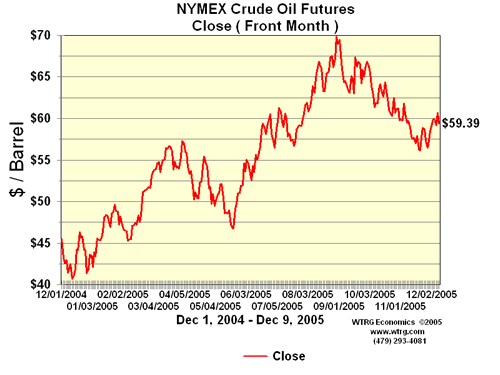
Friday, December 02, 2005
New Fuel Saving Device Increases Gas Mileage up to 35%
On November 29th, is was annouced by scientists that the Enviro-Max Plus Fuel Catalyst is the greatest automotive discovery of our time. Savings up to 50 cents per gallon of gas while protecting the environment. The automotive world is raving about Enviro-Max Plus which is marketed exclusively by Extreme Research Corporation of Dallas, Texas.Enviro-Max Plus is a revolutionary fuel catalyst, not to be confused with the thousands of existing additive products and gadgets already on the market.
It has been used successfully for 9 years by thousands of people, as well as city governments, large trucking lines, railroads,farming, and boating companies.The fact is our country is a country that depends a great deal on cars and trucks as our mode of transportation. The gas prices are inching up closer and closer to $3/gal in many parts of the country and it is burning up our bank accounts and poisoning our environment.The Enviro-Max Plus is a unique product that will impact air quality and fuel economy worldwide. Enviro-Max Plus is used and endorsed by race car driver Jonny Rutherford, three time winner of the "Indianapolis 500".
Documented results of Enviro-Max Plus Fuel Catalyst:
1.Incresed fuel mileage up to 35% on both gas and diesel engines, which can save over 50 cents per gallon or $10 per fill up of 20 gallons.
2.Provides up to 80% reduction in emissions ofexhaust pollutants, protecting our air and environment.Imagine the possibilty of smog free,clear skies for future generations.
3.Saves on engine repairs and/or tune-ups by reducing engine wear and tear.
4.Increases horsepower and performance in all gas and diesel engines.
5.Will not harm engines or void any warranties.Our Vital Mission...Help drivers stop throwing away money at the gas pumps and help protect the environment now and for future generations.
Lee Perry, an independent co-partner with Extreme Research Corporation is lauching a national promotion, seeking representatives from all 50 states who want to stop being part of the problem, and become part of the solution.Anyone interested in representing or using this product may visit my website at http://www.sbradley.myextremeresearch.com/ for complete details on the product and financial opportunity.
IRS adjusts mileage rate to 44.5 cents
Today the Internal Revenue Service change the mileage deductible rate that workers can claim next year for using personal cars on business at 44.5 cents a mile. This rate is less than the temporary rate that the tax agency put in place for the last four months of this year, reflecting higher prices at gas pumps nationwide. The temporary rate is 48.5 cents a mile.
Read entire article
Friday, November 25, 2005
Speedway Rewards program - Gas discounts
Speedy Rewards transforms your everyday Speedway and SuperAmerica convenience store experience! Now every time you make a purchase, excluding restricted items, you will immediately start earning points towards gasoline discounts (where applicable) and/or free merchandise, as well as coupons for valuable savings just for using your Speedy Rewards membership card inside the store or at the pump! You can even instantly review and/or redeem your points simply by using the Speedy Rewards redemption terminal located inside the store.
Energy Efficiency Windows - Save Gas with Insulated Blinds

You may not spend much time thinking about your windows. On beautiful days, you enjoy the view. On cool summer evenings you may open your windows to enjoy the smell of fresh flowers and the sounds of night owls.
But what about when the cold of winter hits? You close your windows to keep the icy air out, but when the snow blows and the cold wind howls, do you still feel cold drafts coming in? Have you ever thought about the warm air inside your home you've paid to heat that is seeping out those drafty windows? The average American home spends about half its energy costs in heating and cooling the home. Investing in energy efficient window treatments may be the wisest decision you ever make!
Shop For Window Blinds

Weatherizing Your Home to Save Gas and Reduce Heating Cost
Weatherizing Your Home--Weatherstripping:
This guide discusses the practice of weatherizing your home through weatherstripping. Selection of materials, types of weatherstripping and buying and installing these products are discussed. Goto guide
Michigan Rideshare - Car pooling to save gas
What is Ridesharing?
Rideshare is a free, computerized carpool and vanpool matching service that assists individuals and groups with their daily work commute. There are thirteen Local Rideshare Offices (LRO) in Michigan that provide services for commuters commuting into and within their region.
Find a Local Rideshare Office near you. Rideshare assists in forming carpools and vanpools. MichiVan, a vanpooling program sponsored by the Michigan Department of Transportation, will supply fully insured 9 or 15 passenger vans to groups of 9 or more commuters, with cost to be shared among the riders. Rideshare helps employers develop and implement ridesharing programs for their employees. Rideshare also provides a Guaranteed Ride Home Program (GRH) to all registered carpool and Vanpool participants.
The following MDOT publications are available in PDF format:
Rideshare Brochure
Rideshare participants can conveniently take advantage of the Michigan Department of Transportation carpool lot program. There are 216 carpool parking lots located across the state providing over 8,000 parking spaces. Approximately 2,500 vehicles park in these facilities on an average weekday.
For Information: Jean Ruestman 517-373-6625 ruestmanj@michigan.gov
Ride-sharers driven by rewards - Save Gas - Car pool for rewards
NuRider service offers commuters flexibility, along with incentives such as gift cards
Cheryl Moeller fancies the idea of being paid — rewarded, even, in the form of gift cards — for what she's already doing.
She and her husband have been commuting together for more than four years. She's a real estate analyst for the El Paso Corp. and her husband, Jim, works for the city of Houston's Neighborhood Protection Corps. They live in far west Houston, almost to Katy, and their commute downtown takes about 35 minutes, mostly in the High Occupancy Vehicle lane.
Since late August, when they enrolled in the NuRide ride-sharing program, the couple has earned two $35 gift cards from Shell and two $25 cards from T.G.I. Friday's restaurant. By using one vehicle, they have also saved roughly $410 in gasoline, limited wear and tear on their pickup and eliminated a ton or so of emissions that would otherwise end up in Houston's air.
"The big attraction was the rewards. NuRide pays us to do what we'd already been doing for all these years," Moeller said.
NuRide, first launched in the Washington, D.C., area in March 2004, is the nation's first incentive-based, ride-sharing program. It started in Houston on Aug. 1, and some 2,100 commuters have enrolled in the program, which is administered by the Houston-Galveston Area Council.
"We've made it convenient as possible. You do it all online, you pick who you want to ride with, when you want to ride, everything. You customize it your own way," said NuRide spokesman Michael Nolan, based at the program's headquarters in Arlington, Va.
For each commute, participants are awarded points, redeemable at various businesses for gift cards and other rewards.
NuRide members pick the days and times they would like to share rides, almost like booking an online airline ticket. The program — at www.nuride.com — matches riders with others traveling to the same destination, and its flexibility enables them to ride daily or once a month.
For security, NuRide is set up through employers, which permits verification of each rider's identity. Participants must have an at-work e-mail address. A potential ride-sharer researches other NuRiders by clicking on their user names to reveal where they work, their travel information and their rating by other NuRide members.
"That's what I like best — the flexibility. It's almost like online dating — not that I've ever done that," said Colleen Martin, education manager for the urology department at Baylor College of Medicine.
Martin joined NuRide in early September and now shares rides with a man and a woman from her neighborhood who had already been car pooling and who also work in the Texas Medical Center. They rotate driving every three weeks and split the center's $150-per-month parking fee.
"I'm an ecologist. That's my main motivation. I care about our finite resources and I can't stand the crowded freeways, but I like the rewards, too," said Martin, who has earned gift cards from Shell, Old Navy and Home Depot.
Nationally, Nolan said, NuRide has about 9,000 members who have shared 150,000 commutes, resulting in 4.5 million fewer miles driven and 2,000 fewer tons of emissions.
Source
Thursday, November 24, 2005
Space Heaters - Reducing Your Home Heating Costs
When winter approaches many of us are scurrying around trying to find the best space heater. This year oil and liquid propane gas prices have sky-rocketed and people are thinking about just heating the space they are using, as opposed to keeping the whole house “up to speed,” heat wise. There are many heaters from which to choose. Some of them are the old standbys and some of them are fairly high tech. So, here’s a primer that may help you sort through the sale flyers you are receiving from the home stores, and figure out what you want, and what you need in a space heater.
Electric Heaters
Convection Heaters. These heaters have heating coils running through them and heat up very quickly. Most of these heaters have a thermostat that will cycle the heater off and on according to your desired heat level. The coils in these heaters get red-hot and they can easily be a fire hazard. My convection heater turns off if it is knocked over, but all heaters don’t have this feature. Mine also became a lot louder to operate after I tripped over it! The convection heaters have small fans that circulate the warmth throughout a room. This heater works well if you want to heat more than one person in a room. The fan usually has a setting for just air, which is a nice feature in the summer. You can purchase one with different heat settings (750, 1000, and 1500 watts). As a rule, the more settings a heater has, the more expensive it is to buy. These heaters can be a safety hazard if you have toddlers around the house.
What is a watt? When trying to figure out how effective a particular heater will be in the space you need heated, it is good to know some comparisons of heating lingo between electric and other fuels. Most fuels besides electricity are measured in BTU’s. Your fuel oil furnaces, kerosene heaters and woodstoves all are rated with BTU’s. You’ve probably heard it before, but what does it actually mean? A BTU is a British Thermal Unit, and one BTU is the amount of heat needed to raise the temperature of 1lb of water 1 degree Fahrenheit. Furnaces can be rated 80,000 BTU’s. Many gas heaters have a rating of 39,000 BTU’s. Kerosene heaters are usually around 15,000 BTU’s. Electricity, however, is measured in wattage. If you multiply the number of watts by 3.41 you will get the amount of BTU’s you can expect from the heater. 1500 watts X 3.41 = 5115 BTU’s. Electric space heaters are usually much lower in their heat output than kerosene heaters, but for many rooms a heater giving off 15,000 BTU’s would drive you out!
Ceramic Heaters
This second type of electric heater is new on the heating scene. It delivers quite a bit of heat from a little box. It is highly portable and doesn’t use as much electricity as the coil type of heater. Some of the disc heaters are equipped with a rheotstat that sends full voltage to the element when the room is cold and slows down its output of electricity to the fan as it heats up. This is a nice feature, but it can override your own choice of the desired temperature for your room.
Oil Filled Radiant Heaters
These heaters look like an old fashioned radiator. They are electric heaters that are permanently filled with oil. They also seem to use less electricity than the coil type of electric heater. Most of the models come with wheels on them for easy portability. Although these take a little longer to warm up a room, it is a steady, economical heat source. Many people seem to be very satisfied with this type of heater.
Non-electric heaters
Kerosene heaters(non-vented)
These heaters would be the next step up in heating larger areas, and garages. As they are unvented it is recommended that you don’t use them in an enclosed area, but many people do. The heaters are radiant and have a wick that soaks up kerosene from a refillable tank. Most are equipped with automatic shut-offs if the heater is tipped or knocked over. They are about double the heating capacity of the largest heater mentioned above.
Natural or LP Gas Heaters(Non Vented)
Very popular heaters that require no venting according to the manufacturer. Many of these are wall mounted heaters, or come on a base. They need to be hooked up to your natural gas line, or a propane cylinder. Some brands come with oxygen depletion sensors that will shut the heater down if the air is getting oxygen poor. This could result in carbon monoxide poisoning. These can have heating capacities up to about 39,000 BTU’s. Today’s decorative fireplaces and even heaters that look much like wood stoves, can have gas as their fuel source. There are also vented models that only have to have a pipe that goes through the wall of an exterior wall. When you are figuring out how fast you will go through your tank of LP gas, remember that a gallon of LP is actually 4.25 pounds.
Wood Burning Heaters
Very popular in the 1970’s wood burning heaters have taken a second place to gas heaters, however, with the high price of gas and oil they are making a comeback. The biggest drawback to using a wood burning stove is that it requires an adequate (and usually expensive) chimney system that extends above the roof line. You must also follow certain safety guidelines about the placement of the stove in relation to the floors and walls. Check with your insurance agent before having a wood stove installed.
When you purchase your space heater, be sure to read the safety guidelines carefully. Remember, if your clothing does catch on fire, don’t run. Drop and roll to extinguish the fire. Teach all the members of the household about safety issues with the new heater. If you are using a heater that burns kerosene, LP or natural gas, or even wood you should also have a carbon monoxide detector installed on every floor of your house.
Source
Home Heating Costs Save Money on Heating Costs
WSJ had an interesting chart on the cost of heating your home. Whats interesting is that the chart indicates that heating your house with electricity is less expensive than natural gas. The primary reason for this is the dramatic increase in the price of natural gas, heating oil and propane over the past 2 years. I am not sure if I believe this but I will do some additional research and check into it.
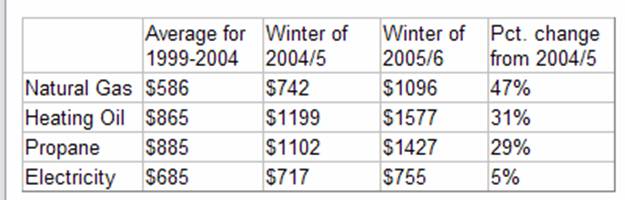
Below are some tips on reducing your home heating costs.
Reduce Heating Costs With These Money Saving Tips from About.com. If you live in a region that is cold in the winter, heating costs take a big bite out of your monthly budget for 25 - 50% of the year. Due to the rapidly escalating costs of home heating oil, propane, and kerosene, you may be paying twice as much to heat your house as you did just a few years ago. You can cut your heating costs significantly by following these money-saving tips.
- Do an energy audit of your house, identifying areas where heated air is leaking out. Check around doors, windows, fireplaces, and other areas that may feel drafty. Use caulk, weather stripping, door sweeps, plastic, and other appropriate means to close off these leaks. If your house is poorly insulated, adding additional insulation will pay for itself in reduced heating costs.
- Minimize your use of ventilation fans such as bathroom fans and kitchen hood fans in winter. A bathroom fan can suck all the heated air out of the average house in little more than an hour. Over the course of the winter, ventilation fans can increase your heating costs by a surprising amount.
- Don't heat areas of your house you don't use regularly, such as guest rooms. Close heating vents or turn back thermostats in those areas and close the doors for a painless reduction in heating costs.
- Turn down the heat and use space heaters to heat the room you spend time in.
- Keep your furnace, heat pump, or other heating equipment in top operating condition. Dirty filters reduce the efficiency of your furnace or heat pump. Poorly tuned units are inefficient and use more fuel. An annual maintenance agreement is well worth the money to ensure that your equipment is properly maintained and will last as long as possible.
Don't turn your thermostat up above the desired temperature. It won't heat up any more quickly and will make your furnace work harder. Also, while it makes sense to turn the heat back when you're sleeping or not at home, turning it down too low can actually cost you more because the contents of the house have to be re-heated in addition to the air. 68 to 70 degrees while you're home and awake, and 60 to 65% while you're asleep or not at home are reasonable temperatures. - Consider a programmable thermostat to raise and lower the temperature at pre-set times.
- Check the temperature setting on your hot water heater. If you have a dishwasher, your water should be heated to 120%. Otherwise, it can be somewhat lower. If your water heater is in an unheated space like an unfinished basement, wrap it in an insulation blanket available at hardware stores to prevent heat loss. Wash clothes in cold water whenever possible.
- It's tempting to stand under a hot shower on a cold morning for as long as possible, but cutting your shower time in half can save up to 33% on your hot water heating costs.
- In winter, open the blinds and curtains on the sunny side of the house (the south-facing side) when the sun is shining and close them as soon as the sun goes down to retain the solar heat. Close curtains on the shady side of the house (north-facing side). If you don't have curtains, consider installing some. Curtains made from heavy fabric with lots of folds (fullness) can prevent cold air from seeping in and warm air from seeping out, which reduces your heating costs.
Wednesday, November 23, 2005
ScanGauge MPG Gauge

ScanGauge - A Plug In Digital Gauge That Displays Car. Tested on Hybrid Cars and Non Hybrid Cars
Guide Rating -
ScanGauge is Linear Logicas 3-in-One automotive computer than reads information from your car's computers and displays it on a backlit digital screen. It integrates a Scan Tool, Digital Gauges, and a Trip Computer into one self-contained unit. No tools are needed to install it because it plugs into the diagnostic connector found under the dash on 1996 and newer cars and light trucks.
I tested the ScanGauge on several hybrid cars and non hybrid cars over the past few months and have been pleased with its usefulness. It was especially helpful to provide feedback to improve fuel economy in non hybrid cars as well as provide more detailed information that is not available in some hybrid cars.
As a scan tool it reads and displays engine trouble codes which can then be cleared/reset via the ScanGauge. It can also reset the dreaded Check engine light. I was able to use this feature with ease on both my hybrid car and my non hybrid car. Heck, this feature alone saved me two $70 trips to the car dealer to get that darn light reset.
As A Set Of Digital Gauges
The ScanGauge is very intuitive making it easy to quickly move it between hybrid cars and non hybrid cars alike. It has the ability to display up to 4 of the 12 predefined gauges on its realtime display screen while still allowing you to easily toggle to the remaining 8. In non hybrid cars I generally set the gauge to display the RPM, MPG, Water Temperature and Gallons per hour. In hybrid cars I often had RPM, throttle position, intake air temp, and Water Temperature displayed. Again, you can change any of these selections with a press of a button. While I found it did not read all info on all cars, it did a pretty good job getting the info I needed. (Go to page two of this review for the full list of 12 gauges available.)
As A Trip Computer
In addition to the instantaneous readout, it also tracks three additional sets of trip data including current trip, cumulative for today, and cumulative for the previous day. For these trips it can track maximum RPM, speed, and coolant temperature, as well as driving time, driving distance, amount of fuel used, and trip mpg. The ScanGauge does not have the ability to export data to an external source, but that seems common for units in the under $150 price range.
Why Would You Want One?
For Cars That Do Not Have An Instantaneous MPG Gauge. Often people ask me how they can improve their fuel economy. While hybrid cars have gauges that give fuel economy feedback, usually non hybrid cars do not. With ScanGauge, non hybrid cars can now have fuel economy information at their fingertips, too. Drivers can immediately see the fuel economy difference between driving 75 mph and 65mph. What they do with this knowledge is up to them.
For Hybrid Cars That Do Not Provide Data You WantEven though hybrid cars come with lots of neat gauges, sometimes there is still a desire to see even more detailed information. What exactly do the segments on the temperature gauge equate to in real numbers? What RPM is the engine spinning? What is the intake air temperature? The ScanGauge can answer these questions and more.
Two Caveats For Hybrid Car Owners. First, I found the ScanGauge mpg calculations cannot accommodate the lean burn engine found in specific hybrid cars, such as the 5-speed Honda Insight. If tracking mpg in your lean-burning vehicle via the ScanGauge is of utmost importance, you may want to skip the ScanGauge for now. I do not expect a current update to this unless there is enough demand.
Second, the ScanGauge does not compute mileage when a hybrid cars Internal Combustion Engine is not running. (Stealth mode as some hybrid car owners call it.) There may be a future correction for this, but if tracking mpg in your hybrid car via the ScanGauge is important toy you, you may want to wait until this is feature is updated. In the meantime you can ask Linear Logic to put you on a waiting list and they will contact you when this particular update is made. As a side note: If you are a hybrid car owner in the Phoenix area, you can help get the update to market more quickly by contacting Ron Delong at ScanGauge and allowing him to try out the beta version of the hybrid-car-tweaked unit on your car before they produce them for the rest of the hybrid car owners. Contact Ron via email at scangauge@linear-logic.com
Conclusion
Overall the ScanGauge is fun, easy to use, and works as promised. First, as a scan tool it efficiently allowed me to view and reset engine trouble codes, and reset the Check Engine light in both hybrid and non hybrid cars. Secondly, as digital gauges it provided the feedback needed to improve fuel economy in non hybrid cars. It also displayed detailed engine information that was missing on hybrid cars. And although it was not always effective at calculating fuel economy in hybrid cars, the fuel economy calculation for non hybrid cars was right on.
I find the ScanGauge to be a good value, and with a 30 day money back guarantee, it is clear the company stands behind its product.
Technical Details Price $129.95 Goto ScanGage Website
Features:
- Scan Tool Feature
- Reads Trouble Codes
- Reads conditions that set the Trouble Code
- Clears Trouble Codes
- Turns off "Check Engine" light
- Make and store up to 10 rewritable special codes to send to the vehicle computer
12 Digital Gauges Available (Four Can display at one time, with the rest available to toggle through.) - Fuel Economy (MPG - gasoline engines only)
- Fuel Rate (GPH - gasoline engines only)
- Battery Voltage
- Coolant Temperature
- Intake Air Temperature
- Engine Speed (RPM)
- Vehicle speed (MPH)
- Manifold Pressure (not available on some vehicles)
- Engine Load
- Throttle Position
- Ignition Timing
- Open/Closed Loop
- Trip Computer info Automatically tracks three sets of trip data - Current (short) Trip Days (total) Trips Previous Days Trips
- Maximum Speed
- Average Speed
- Maximum Coolant Temperature
- Maximum RPM
- Driving Time
- Driving Distance
- Fuel Used (Gasoline engines only)
- Trip Fuel Economy(Gasoline engines only)Dimensions5.2" wide by 2.7" high by 2.1" deep.
- The cord from the diagnostic connector to the control/display is 8' long and about 0.2" in diameter.
Source
Monday, November 21, 2005
EPA TO REVISE CAFE TEST
The U.S. Environmental Protection Agency is working on updates to the procedure it requires for estimating vehicle fuel economy in an effort to make results more realistic. The agency is likely to propose changes by about the end of the year, although adoption won’t occur until sometime next year. EPA says the proposed changes—the first in 21 years—could reduce the official fuel economy numbers for at least some vehicles by as much as 10%, says The Wall
Street Journal. The current test procedure assumes average city and highway speeds of about 21 mph and 49 mph, respectively. But the agency says motorists actually cover between one-third and one-half of the total miles they drive at speeds above 60 mph. It says drivers also accelerate and brake harder than the original test specifies. The agency also notes that the current test doesn’t consider the impact of such things as running the airconditioning
system on a hot day.
Saturday, November 19, 2005
Save at the pump by maintaining your car
High fuel prices make motorists more concerned than ever about saving money at the pump.
Relief is here: keeping up with regular vehicle maintenance can improve fuel economy. Clogged fuel injectors and air filters, dirty spark plugs and underinflated tires make engines and other vehicle components work harder and consume more gas.
"With our busy lifestyles, taking the time to have routine vehicle maintenance performed can seem like busywork, but it pays off in numerous ways," said Peter Lord, executive director, GM Service Operations. "Regular vehicle maintenance and inspections can help improve a vehicle's fuel efficiency and achieve peak performance."
Travel Tips
- Be a Planner: Map your route beforehand to maximize efficiency.
- Control Clutter: Avoid packing unnecessary items-according to the Environmental Protection Agency an extra 100 pounds in the trunk can reduce fuel economy by up to 22 percent or about six cents per gallon.
- Take a Cruise: Cruise control helps you maintain a constant speed on the highway and can help save gas.
- Avoid Idling: It's a prime fuel waster. When tailgating, don't use the vehicle's heater to keep warm; bring a boom-box to listen to the pre-game instead of the car radio.
- Drive Smart: Hard starts, stops and other forms of aggressive driving can reduce fuel economy 33 percent on the highway and 5 percent on city streets, according to the EPA. Motorists can save between 15 cents and $1.01 per gallon driving sensibly.
- Relax: Contrary to popular belief, the faster you go, the more fuel you use. The EPA estimates every five miles you drive over 60 mph equals an extra 21 cents per gallon of gas. Plan ahead and allow yourself a little extra time. When possible, drive your household's most fuel-efficient vehicle.
Fuel saving tips
Some good fuel saving tips from KVEU Austin:
- Don't top off the tank. Overfill can slosh out of the tank and waste gas.
- Consider filling up at cooler times. Gasoline can expand in the heat and overflow.
- Gravel and dirt roads can cut fuel efficiency by 30 percent. Urban pot holes can have the same effect, but try to keep your route smooth.
- Keep your car clean. One government study finds a clean car can get up to 7 percent better fuel efficiency. "The
 amount of dirt and grim that we keep on our car increases something called the coefficient of friction between our car and the atmosphere," said Summer Smith, with The Science Place. It's the same principle that makes tire pressure so important. I like to use the $4 touchless wash. I use it in the morning and it doesn't take more than 4 minutes to wash my car.
 - Minimize idle, for example when you goto the drive through look inside first most of the time the line inside is smaller and you probably need the exercise.
- Park in the shade. A/C compressors tax the engine and lower efficiency.
- Try to park so you don't have to back out. Reverse maneuvering uses more gas.
- Tip number eight dispels a myth about keeping the windows rolled up. Turning off the air conditioning and rolling down the windows does not save fuel. In fact, at highway speeds the drag can cut fuel efficiency by ten percent. However, if it is cool enough just to run the vents ten shut the air off and use the vents.
Friday, November 18, 2005
SURVEY: PICKUP BUYERS VALUE FUEL ECONOMY.
Contrary to their image as stump-pulling guys hungry for horsepower, pickup truck owners these days are much more interested in better fuel efficiency, according to a new survey by R.L. Polk & Co., the auto industry’s oldest statistical service. The poll, which was commissioned by New York Citybased environmental advocacy group Environmental Defense, finds fuel economy ranking three times as important as passenger space, the next most-cited attribute, among truck owners The survey says trucks are used 80% of the time for personal use. Towing, hauling and off-roading were each mentioned by only 4% of owners. Environmental Defense says it plans to submit the study to the U.S. Dept. of Transportation to bolster its argument for higher fueleconomy standards for trucks
Wednesday, November 16, 2005
HONDA’S LATEST HYBRID: A TRIPLE-MODE SNOWBLOWER
Honda Motor Co. has developed a new hybrid snowblower that uses electric motors for propulsion and a gasoline engine to drive its snowblowing mechanism and recharge its battery. It’s the fourth model in the company’s hybrid snowblower lineup, which debuted its first model in 2001. The new midsize gasoline-electric system generates up to 15 hp and features an advanced control unit that regulates throttle opening to maintain the same speed as load conditions change. Users also can preset snow discharge distances. Honda has sold more than 20,000 hybrid snowblowers since introducing the technology four years ago. The new SM1590i model is the first midsize blower to use a hybrid drive and the first with three operating modes: auto, power and manual.
Honda Posts


